Tone
You can make specific areas of your body toned and defined as opposed to big and bulky by lifting a light weight for roughly eleven thousand reps.
Want sculpted shoulders that look like scalloped seashells, the kind mermaids keep their lip gloss in? Grab a pastel-colored, plastic-coated dumbbell (the one your aunt keeps next to her yoga mat she’s used twice) and do lateral raises until your delts are screaming louder than a toddler denied a Capri Sun. Make your muscles burn so hard chlamydia seems like child’s play.
Do this for every major muscle group and you’ll look like Tyler Durden before next Tuesday.
Or so the story goes.
Unfortunately, if lifting a light weight for high reps was an effective way to increase muscle tone and definition, then every childcare worker on planet Earth would be walking around looking like a Calvin Klein ad.
These people are CONSTANTLY hoisting babies. (And, depending on the week, bottles of Cabernet.) Light weights, you know? And yet. Childcare workers do not, as a general rule, have biceps shaped like veiny little baguettes. Unless! Being toned and defined is like time travel, where going forward at Ludicrous Speed® sends you backwards, and the squishier and softer you get, the MORE jacked you secretly are? Are childcare workers just so absurdly toned that they’ve wrapped all the way back around to looking like a soft pretzel?
You’re more than welcome to explore this theory, but I’m putting my money on lifting a light weight for high reps being dumber than daytime television.
The best way to become more toned and defined is, weirdly enough, to stop training for tone and definition.
Slap somebody’s arm down on a table and — stay with me — saw their bicep clean in half. (Hypothetically. We are not doing this. Put the saw down.) What you’d find is a big ol’ bone, wrapped in a steak (that’s your muscle), wrapped in mashed potatoes (that’s your fat), wrapped in plastic wrap (that’s your skin). Your entire physical appearance is just a casserole of these four ingredients. Want to change how you look? Then you gotta change one of the ingredients.
Let’s rule out the obviously insane options first: bone and skin. Unless your five-year plan involves early-onset osteoporosis or skinning yourself alive like some kind of regional horror movie villain, those two are off the table. Which leaves us with the two dials you can actually turn: the steak (muscle) and the mashed potatoes (fat).
Here’s where things get trickier than rocking a rhyme: You can’t “tone” or “define” either of these attributes.
Muscles can either grow and get bigger, or they can shrink and get smaller. There is no special way of growing (or shrinking) a muscle that makes it “more toned” as opposed to “less toned.” (Not even sarcoplasmic hypertrophy. Story for another day.) In other words, you can’t tenderize your meat. There are bigger muscles. There are smaller muscles. There are no lean, toned, or defined muscles. Those words do nothing. They are decorative throw pillows.
Same deal with body fat — or, to use its fancier, more respectable government name: adipose. You can pile more of it on and get squishier, or you can melt it down and get harder. There is no premium, artisanal, small-batch adipose that makes you look MORE chiseled. All fat — visceral, subcutaneous, the weird brown kind scientists get excited about — sits on top of your steak amd obscures the view like fog.
Which begs the question:
If muscle mass and body fat can’t be toned or defined, how does one become toned and defined?
The secret is annoyingly simple. Appearing toned and defined is a byproduct of quantity, not quality. Golden Corral had it right all along. You need a mediocre amount of muscle mass, and a low amount of adipose. Miss the mark in either direction and your chances of looking toned and defined will sink faster than Squints in The Sandlot. (If that reference meant nothing to you, I regret to inform you that we cannot be friends. It’s not personal. It’s contractual.)
Look at impossibly skinny runway models. They don’t have much adipose, which is good for tone and definition. Adipose is mushy, like mashed potatoes. If you lather a steak with mashed potatoes, you won’t be able to see the steak’s striations. Unfortunately, super-skinny runway models don’t have much muscle mass; they don’t have steaks. They have a few tissue-thin slices of salami stuck to their skeleton. There are no striations to see, so they look like conscious coat hangers. They’d look more toned and defined if they gained muscle.
On the other end of the spectrum, there are heavyweight powerlifters and off-season bodybuilders. (The legendary Doug Hepburn comes to mind.) They have a bunch of muscle mass, which is good for tone and definition. Big steaks are dense and detailed.
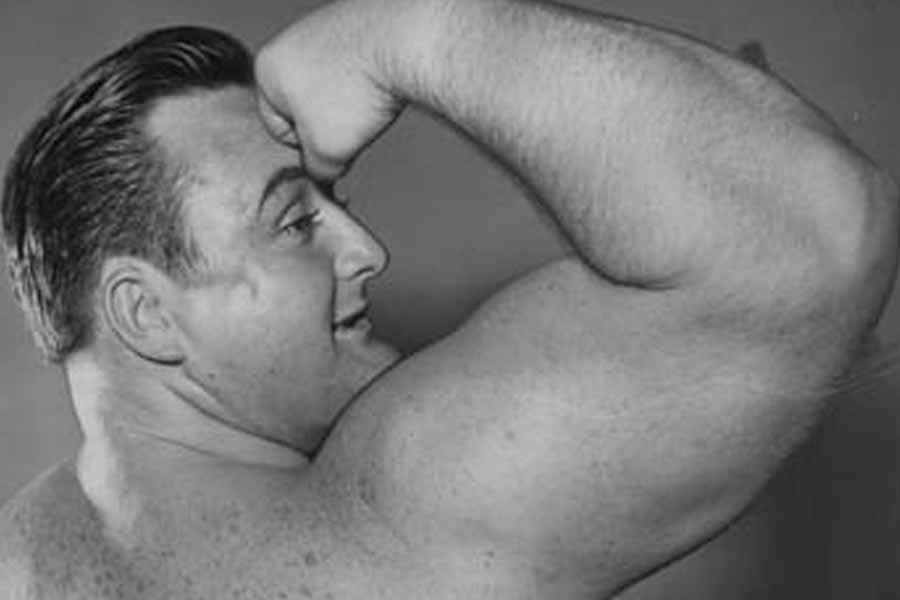
Unfortunately, heavyweight powerlifters and off-season bodybuilders also have heaps of adipose; their muscles are covered in mountains of mashed potatoes. This suffocates the subtleties of the steak, smothering every striation. So instead of looking chiseled, they look like swollen sausages.
Between both extremes exists toned and defined bodies, like that of Brad Pitt in Fight Club and Brie Larson (who I only look at for research purposes). Their muscles are big enough to display detail, and their body fat levels are low enough to put the details on display.
Appearing toned and defined is a game of quantity more than quality: You need a big (enough) muscle and a low (enough) body fat percentage.
So if you aren’t as toned and defined as you like to be? You have two options. Lose fat. Or build muscle. Statistically, you probably need to do both. Skinny-fat guys (a group I have, let’s say, “personal field research” in) tend to overestimate how much muscle they have and underestimate how much fat they have.
Could I be wrong about your specific situation? Sure. You might already have sizable steaks, which means you should focus more on fat loss. Or you might already have minimal mashed taters, which means you should focus on more muscle growth.
I don’t know.
But I do know this:
There are dead wasps inside of figs. (Seriously, look it up.)
I also know this:
Training for tone and definition won’t help you lose fat or build muscle.
When knuckleheads train for tone and definition they usually lift a light weight for high reps, trying to make their working muscles burn. In order for this kind of training to have an impact on tone and definition, it’d either have to contribute to fat loss or contribute to muscle growth. Prepare yourself. It does neither.
I don’t care what the woman in the head-to-toe Lululemon told you between sips of her green juice: lifting something light will not trigger muscle growth no matter how many reps you grind out, for the same reason tickling your arm with a feather will never, ever produce a callus. The stress just isn’t big enough to make your body bother adapting. And the burn sensation that usually accompanies high-rep training? Doesn’t mean you’re burning fat.
I’m not sure who popularized the term “burning fat,” but whoever it was should have their private parts knuckle-punched. Fat doesn’t combust. It doesn’t smolder. It doesn’t even get warm. It gets quietly metabolized through chemical pathways with names like “beta-oxidation” that nobody’s ever going to put on a gym tank top, so undramatic, so utterly silent, that your body could be dissolving a love handle right now and you’d have zero physical sensation to show for it.
The burn sensation you feel mid-set is just lactic acid throwing a tantrum in your muscle. It’s loud. It’s dramatic. And it has nothing to do with the fat sitting six inches away, unbothered, watching the whole thing happen.
All of this means lifting light for high reps is, scientifically speaking, less effective than Goldeen in Super Smash Bros. (If you know, you know. If you don’t, bless you. Truly. Ignorance is a gift.)
Increasing the size of a muscle and decreasing the amount of fat surrounding the same muscle (to a significant degree) with one single exercise or training technique is impossible. Becoming (more) toned and defined has been and always will be a two-part process. You have to grow your muscles. You have to eliminate adipose. And if you aren’t doing either of these things, then you aren’t gonna be tightening or firming or toning or defining much of anything. Except, perhaps, a deep and abiding resentment toward your own body.